
In one of our previous blogs, we talked about braking assist systems such as ABS, EBD, and BAS. This time, we’re switching from stopping safely to accelerating safely. Let’s take a closer look at the Traction Control System (TCS) — also known in some vehicles as ASR, TRC, DTC, or PTC.
We start with ABS for a reason: traction control systems operate as an extension of the ABS architecture. Just like ABS, TCS was originally developed by Bosch and integrated as an additional module to work in tandem with the braking system. Before diving into the details, let’s clear up the terminology confusion. You might encounter several abbreviations — ASR, TCS, TRC, DTC, PTC — depending on the vehicle manufacturer. Although the names differ, they all refer to the same function: the traction control system. Each automaker simply brands it under their own name, which can make things a little confusing for drivers.
TCS monitors all wheel speeds but primarily compares the driven wheels. If a driven wheel begins to rotate faster than the others, the system identifies this as wheel slip — a loss of traction. When this happens, traction control intervenes. Even if the driver continues pressing the accelerator pedal, TCS electronically limits engine power and, if necessary, applies brake pressure to the spinning wheel. Once all wheels regain equal traction, the system releases control back to the driver and returns to monitoring mode. This ensures smoother, more stable acceleration and prevents wheel spin from destabilizing the car. The result is improved handling, especially on slippery or uneven surfaces, and an overall increase in driving safety.
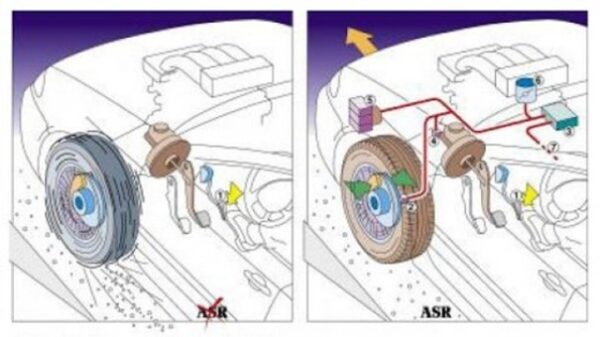
Traction Control System: ASR / TCS
Most modern vehicles allow the driver to temporarily disable traction control via a TCS OFF or ASR OFF button, or through the vehicle’s on-screen settings. That may sound counterintuitive — why turn off a system that enhances safety? In specific conditions such as driving on snow or deep mud, traction control can intervene too aggressively when starting from a standstill. The system reduces engine power so much that the car struggles to move at all. In these rare cases, briefly disabling TCS can help the vehicle gain initial momentum by allowing a small amount of wheel slip. However, once the vehicle reaches a certain speed, most systems automatically reactivate traction control to restore stability. Similarly, when the engine is restarted, TCS typically switches itself back on to ensure safety.

Traction Control System: ASR / TCS


