
ABS (Anti-Lock Braking System)
With advancing technology, vehicles have been equipped with many new driver-assistance systems. These systems are designed to support the driver in critical moments — but still require driver control and awareness. Among the first and most fundamental of these is the ABS, or Anti-Lock Braking System. ABS helps maintain steering control during sudden or hard braking. In vehicles without ABS, the wheels can lock up under heavy braking, causing the tires to skid and the driver to lose all steering ability — the car simply continues in a straight line regardless of how the driver turns the steering wheel.
ABS continuously monitors wheel speed and brake pressure, adjusting the braking force to prevent wheel lock-up. This allows the driver to maintain steering control even during emergency braking. ABS is also the foundation for many other braking and stability technologies. In fact, the systems explained below — such as EBD and BAS — operate as complementary functions built on top of ABS. Without ABS, these additional systems simply couldn’t operate, as they rely on the wheel-speed data ABS provides.
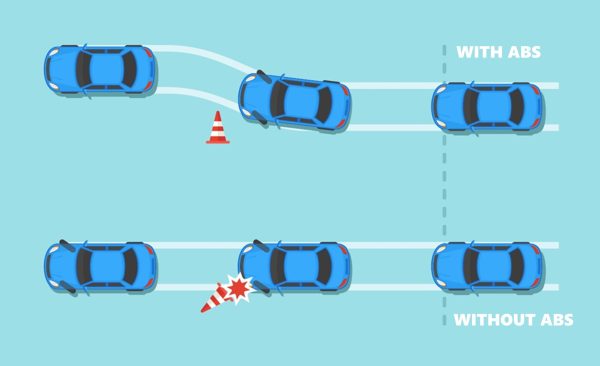
Brake Assist Systems: ABS
EBD (Electronic Brakeforce Distribution)
EBD stands for Electronic Brakeforce Distribution. It’s an additional control function that optimizes how braking force is distributed among all four wheels. Imagine you’re driving on a road where one side is wet and the other side dry. If you brake suddenly, applying equal pressure to all wheels could easily cause the vehicle to lose balance or skid.
EBD analyzes each wheel’s grip level in real time and automatically adjusts the brake pressure accordingly. This prevents the car from veering or spinning out during uneven surface conditions. EBD also considers the vehicle’s load and weight distribution. For example, if the rear seats are occupied or the trunk is full, the system adjusts the front-rear brake balance to ensure optimal performance and shorter stopping distances. By fine-tuning the pressure at each wheel, EBD significantly enhances braking efficiency and overall safety.
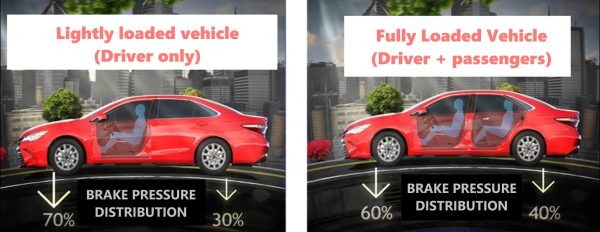
Brake Assist Systems: EBD
BAS (Brake Assist System)
In traffic, time is everything. Even a fraction of a second can make the difference between avoiding an accident and being part of one. Did you know that even an alert driver typically needs about one second to react to a sudden hazard? At 100 km/h (62 mph), that means your vehicle travels roughly 28 meters before you even start to brake. That’s where BAS, or Brake Assist System, comes in. BAS detects panic or emergency braking based on how quickly the driver moves their foot from the accelerator to the brake pedal — and how fast the pedal is pressed. If the system senses an emergency, it automatically boosts the brake pressure to reach maximum braking force faster than the driver could on their own. In critical situations, those extra meters can save lives. Moreover, if the driver doesn’t apply enough force to the brake pedal, BAS compensates by increasing the braking pressure automatically, helping achieve full braking performance even when human reaction falls short.
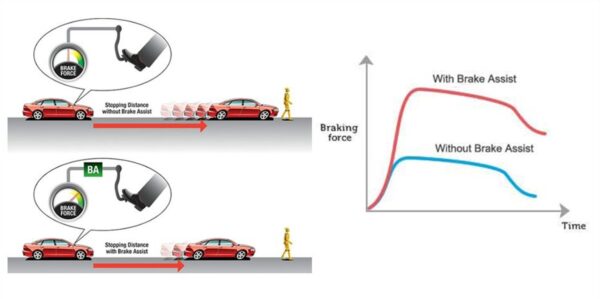
Brake Assist Systems: BAS


