
The Electronic Stability Control (ESC) — also known as Electronic Stability Program (ESP) — is one of the most important active safety systems in modern vehicles. Just like the Traction Control System (TCS / ASR), this technology can appear under different names depending on the manufacturer: ESC, ESP, DSC, VSC, PSM, and more. Different labels, same purpose — to help keep your vehicle stable and under control. Similar to TCS, ESC works in coordination with the ABS. In fact, ESC includes traction control within its system logic. So, if your car is equipped with ESC, it already has the full set of stability and traction systems working together to keep you safe. ESC works by comparing the car’s real-time movement with the driver’s intended path. To make this comparison, it relies on input from several essential sensors; Wheel-speed sensors from the ABS to measure the speed of each wheel, a steering angle sensor to detect where the driver wants to go, a yaw rate sensor located near the vehicle’s center, measuring the car’s rotation — or “yaw” — around its vertical axis.
ESC continuously compares these signals to determine whether the car’s actual motion matches the driver’s steering input. As long as everything aligns, the system simply remains in the background — or, more precisely, remains in monitoring mode without intervening. But if something begins to deviate — for example, the driver turns the steering wheel but the vehicle doesn’t rotate as expected — ESC identifies understeer (when the car does not change direction as the driver intends). Conversely, if the rear of the vehicle rotates more than intended with only modest steering input, ESC detects oversteer (when the rear end steps out).
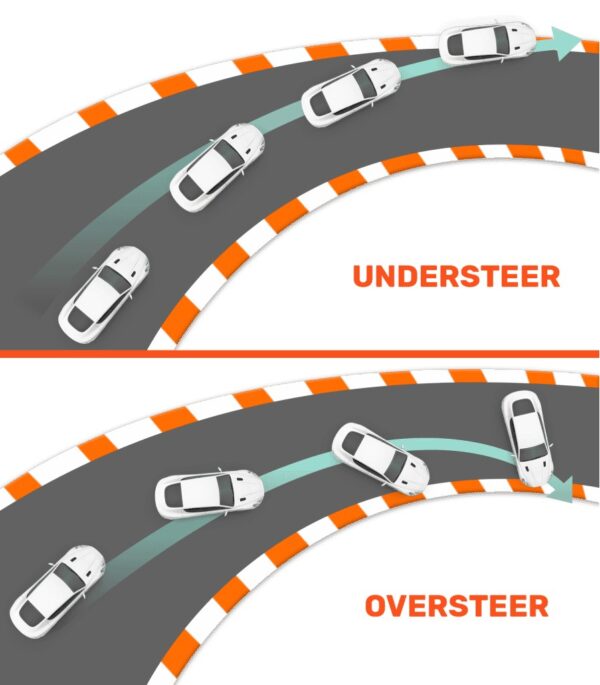
Electronic Stability Control: ESP / ESC
The Electronic Stability Control system is designed to help the driver regain control and continue safely after a loss of traction. Its first action — just as in TCS — is to reduce engine power, even if the driver continues pressing the accelerator pedal. You may have heard misleading advice from so-called “driving experts” claiming that “stepping on the gas helps stabilize a sliding car.” In reality, the opposite is true — and during an active slide, the gas pedal is often partially or completely overridden by ESC anyway.
When the front wheels lose grip (understeer), ESC applies targeted braking to the inside rear wheel — the wheel on the inner side of the turn. This helps the car rotate around that point, much like a tank turns by slowing or stopping one of its tracks. When the rear wheels lose grip (oversteer), ESC instead applies braking to one or more of the front wheels to counteract the rotation and stabilize the vehicle’s direction. In both scenarios, the driver doesn’t need to touch the brake pedal at all — ESC can independently apply precise braking pressure to individual wheels whenever necessary.
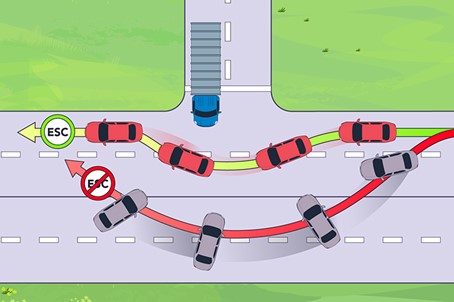
Electronic Stability Control: ESP / ESC


